
PROYECTO ACCESS2SEA
Acrónimo: Access2Sea
Proyecto: Nuevas oportunidades para un crecimiento azul más competitivo y sostenible en la zona Atlántica.
Programa: Programa de Cooperación Transnacional Espacio Atlántico
Prioridad del Programa: Innovación
Objetivo Específico del Programa: Estimulación de la innovación y la competitividad.
Zona Geográfica: España – Portugal – Francia – Reino Unido – Irlanda
Fecha Inicio: 2019-03-01
Fecha Fin: 2022-02-28
Descripción del Proyecto:
La Acuicultura Marina (pescado, mariscos, algacultura) es un sector líder de la economía azul del Área Atlántica que cuenta con una tradición importante en muchos países de la UE y que es relevante en muchas de sus costas, ya que solo el 10% de los mariscos de la costa atlántica proviene de la acuicultura.
En este sector existe una gran oportunidad para aumentar la producción acuícola del Área Atlántica de manera sostenible, siendo este el principal objetivo de Access2Sea. En este contexto, su objetivo es mejorar la explotación y preservación de los activos naturales:
- Desbloqueando las barreras existentes (legales/regulatorias, tecnológico, existencia de áreas adecuadas en zonas costeras, aceptación social) para proporcionar a la industria soluciones técnicas para dar a las empresas acuícolas acceso a la costa.
- Permitiendo la producción en tierra.
- Difundiendo soluciones existentes y nuevas y brindando apoyo a las PYMES acuícolas. De esta modo, se espera que permita a las PYMES evaluar oportunidades espaciales para establecer en el Área Atlántica nuevos negocios de acuicultura, apoyándolos en la explotación de los activos naturales de manera sostenible, así como ayudar a que mejoren su rendimiento a través de la mejora de su modelo de negocio y además de mejorar la aceptabilidad social por las comunidades locales. También se espera que Access2Sea mejore la cooperación entre partes interesadas, organizaciones de apoyo empresarial, institutos de investigación, administraciones nacionales y regionales y consejos locales que facilitan la innovación y la transferencia de conocimientos en el sector de la acuicultura.
Actividades del Proyecto:
| Actividades | |
| WP0 | Preparación del Proyecto. |
| WP1 | Coordinación del Proyecto.
Esta actividad será llevada a cabo directamente por el beneficiario principal, en colaboración con el resto de los socios. |
| WP2 | Comunicación. Este paquete de trabajo que se centrará en las necesidades y objetivos del proyecto en cuanto a comunicación interna y externa será liderado por el CEEI Bahía de Cádiz en España. |
| WP3 | Capitalización.
La capitalización es un proceso por el cual se analiza y evalúa la información y conocimiento existente, así como el conocimiento generado en el marco del proyecto, con el fin de hacerlo disponible y difundirlo a otras organizaciones o regiones, a través de la evaluación de resultados. |
| WP4 | Planificación del espacio para fomentar las actividades acuícolas.
El principal objetivo de esta actuación es abordar la problemática de la acuicultura espacial, construyendo y validando una metodología común. |
| WP5 | Desarrollo de metodologías de aceptabilidad social.
Mediante esta actuación se evaluará el estado del nivel de aceptación social de la acuicultura en los territorios del proyecto e identificará metodologías e iniciativas que demuestren ser eficientes para mejorar la aceptación social con respecto a los sectores económicos / productivos para definir una metodología específica que debería garantizar un nivel justo de aceptabilidad social. |
| WP6 | Construcción de modelos de negocio para granjas acuícolas.
Esta actividad tiene como objetivo mejorar el entorno empresarial y el crecimiento y la creación de empleos del sector de la acuicultura en los territorios del proyecto, abordando los factores clave que impactan en el desempeño y la sostenibilidad de las empresas del sector. |
| WP7 | Proyecto Piloto.
Esta actuación tendrá como objetivo principal el aprovechamiento de las oportunidades comerciales detectadas, apoyar las actividades de acuicultura sostenible (nuevas y existentes) y mejorar la aceptación social de esas actividades. |
Beneficiarios:
| Beneficiarios | |
| Fundación Bahía de Cádiz para el Desarrollo Económico | Beneficiario principal |
| Innovation & Management Centre CLG T/A WestBIC | Beneficiario |
| Údarás na Gaeltachta | Beneficiario |
| Fundación Centro Tecnológico Acuicultura de Andalucía | Beneficiario |
| INVESTIR EN FINISTÈRE | Beneficiario |
| Universidade do Algarve | Beneficiario |
| Tecnopole Quimper-Cornuaille | Beneficiario |
| Swansea University | Beneficiario |
| Centro Interdisciplinar de Investigação Marinha e Ambiental da Universidade do Porto | Beneficiario |
| Technopôle Brest Iroise | Miembro asociado |
| Cuideachta feamainn turtar gorm Teo (TSC-Bleu Turtle) | Miembro asociado |
| Asociación de Empresas de Acuicultura Marina de Andalucía (ASEMA) | Miembro asociado |
| Chambre Syndicale des Algues et des Végétaux Marins (CSAVM) | Miembro asociado |
RESULTADOS DEL PROYECTO / PROJECT RESULTS:
ACCESS2SEA OPPORTUNITIES MAP
Discover our Access2Sea opportunities’ map !
This tool is an Opportunities Map which aims at providing information to onshore and offshore actual and potential aquaculture producers about the best sites and investment opportunities for installing aquaculture activities in the regions involved: Northwest Region (Ireland), Wales (UK), Britanny (France), Andalucia (Spain) and Portugal.
By clicking in the specific locations, you can find different space planning tools which have been improved or identified in the framework of the Access2sea project, which can help you assess the territorial opportunities available for installing your aquaculture business.
Are you interested in Aquaculture Space Planning?
Find other documents developed within the Access2sea Project and other useful information in relation to Aquaculture Space Planning in our page Documents :
- IEF Methodology Transfer
- COMPARISON SPATIAL PLANNING SITUATION in the regions involved (Finistère (France), Galway (Ireland), Andalusia (Spain), Algarve & Porto (Portugal), Wales (United Kingdom)
- Best Practice Monographic
- Methodology Guide: How to set up an onshore aquaculture site with seawater supply?
OTROS RESULTADOS Y ENTREGABLES DEL PROYECTO / OTHER RESULTS AND PROJECT DELIVERABLES:
1. CAPTIALIZATION
Access2Sea Capitalization Strategy is based on 3 pillars:
- The knowledge available that could feed Access2sea from previous projects and other initiativies or strategies.
- The Local Follow Up Committees that have been created to follow up and evaluate different methodologies, procedures and actions to be implemented in their regions.
- The Action for Change Action Plan, which will formally presented and signed by partners at the end of the project, which will define local actions to strenghten the sustainability of the project results.
- Capitalization of available Knowldge
During the first months of the project implementation period, partners have been working on a Capitalization of available knowledge. The result of this work has been compiled in the following report:
2. SPACE PLANNING TO FOSTER AQUACULTURE ACTIVITIES
- IEF Methodology Transfer
One of the objectives of Access2Sea is to deal with the spatial planning: the problematic, building and validation of a common Access2Sea methodology (jointly developed by all the partners).
To achieve this, Access2Sea Partners have been working on a Diagnosis of the current situation in their territories in connection to Spatial planning.
This information was presented during a Transnational Workshop held in Brest, in October 2019 where all the partners and some local stakeholders attended. The conclusions of this workshop were gathered in the following report:
- Knowledge transfer transnational Workshop. Conclusions Report.
- Annex 1: Methodology implemented by «Investir en Finistère», Brest (France)
- Annex 2: Methodology implemented by «Investir en Finistère», Brest (France). Part 2.
- Annex 3. Authorization Process Onshore and Offshore. Finistère (France)
- Annex 4. Space Planning in Andalucia (Spain)
- Annex 5. Space Planning in Portugal
- Annex 6. Space Planning in Wales (UK)
2. Access2Sea Methodology and Indicators Board
Taking into account the results of the previous action, partners have collected data and information about their territories aiming at comparing and sharing each one spatial planning framework. They individually produced a state of art report about their their own reality following a similar structure to allow data comparison. Based on the reports, the workpacket leader have designed a common methodology and common indicators board Atlantic Area partners, have assed the relevancy of shared tool for onshore and offshore sites.
A State of the Art Report with information collected from each of the territories involved in the project has also been written, following a structure that allows the comparison of the situation on each of the territories.
This report is available and and can be downloaded by clicking here:
3. Assessment of the transferability of partner’s Best Practices related to Aquaculture Space Planning: Access2Sea Best Practice Monograhic
Monographic document describing the best practices identified in the project territories.
Access2sea partners have shared their knowledge, methodologies, and experience in relation to the existing MSP tools available, making diagnosis of the starting situation, identifying the most relevant practices that can permit to maintain and develop aquaculture activities, propose spatial planning tools to improve the access to the sea for aquaculture producers and the possibility of transferring them to other Atlantic Area regions.
3. DEVELOPING SOCIAL ACCEPTABILITY METHODS
One of the main obstacles to develpment of aquaculture activities is the low social acceptance these activities and its promoters have for the local coastal communities.
Access2Sea partners are working to assess the state of play of the social acceptnce level of aquaculture in the project territories and identify methodologies and initiatives that had proven to be efficient in improving social acceptance in order to develop an «Access2Sea Social Acceptance Strategy».
- Current state of the difficulties.
The first step to the achieve an «Access2Sea Social Acceptance Strategy» has been identifying the main social difficulties and obstacles that aquaculture activities face.
The result of this assessment has been included in a «State of Play Report», with the data collected by all partners in their regions.
2. Inventory of new consultative initiatives to improve the social acceptability
Access2Sea Partners have worked on the elaboration of an inventory of new iniatives and methodologies to improve social acceptability in aquaculture.
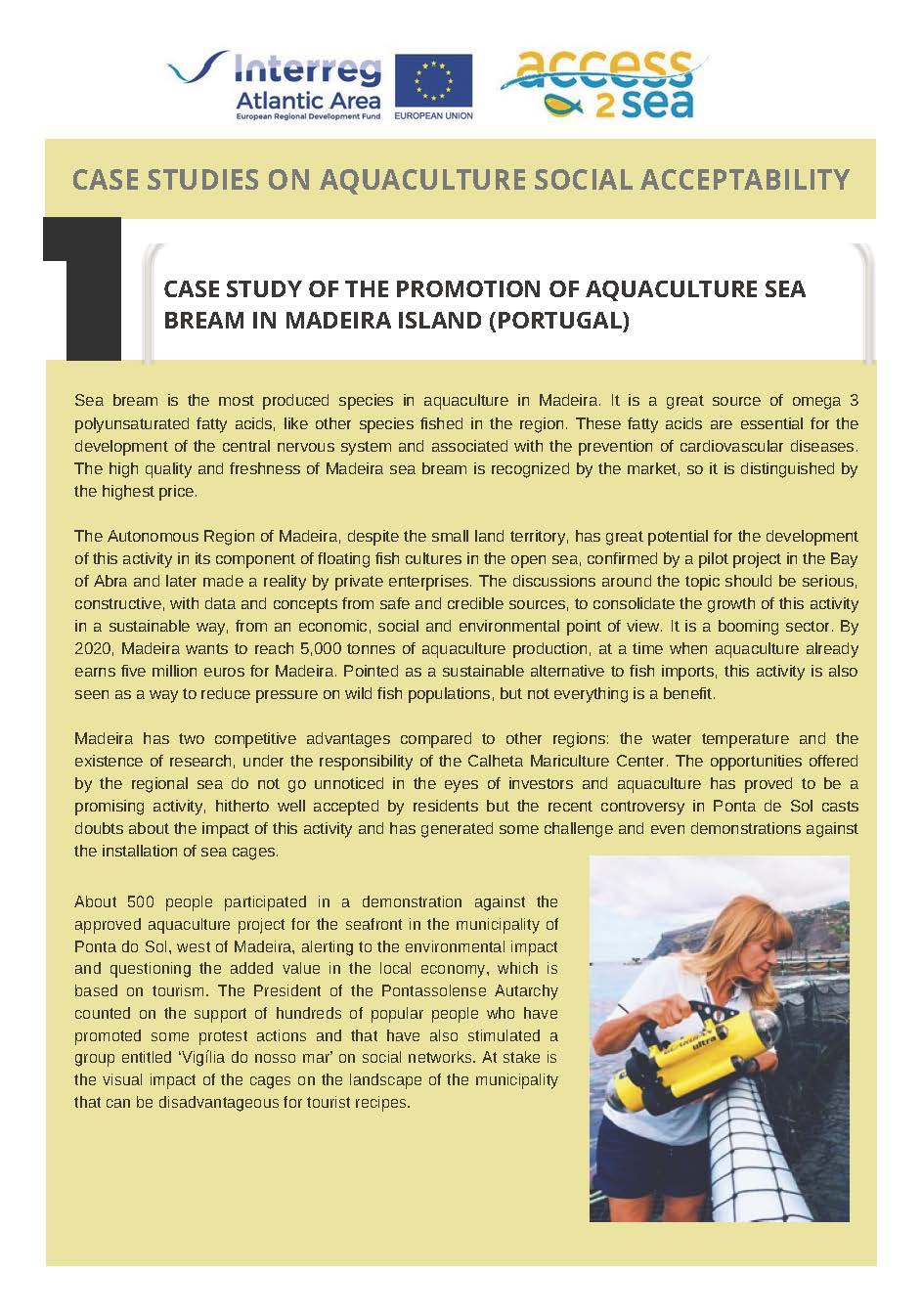
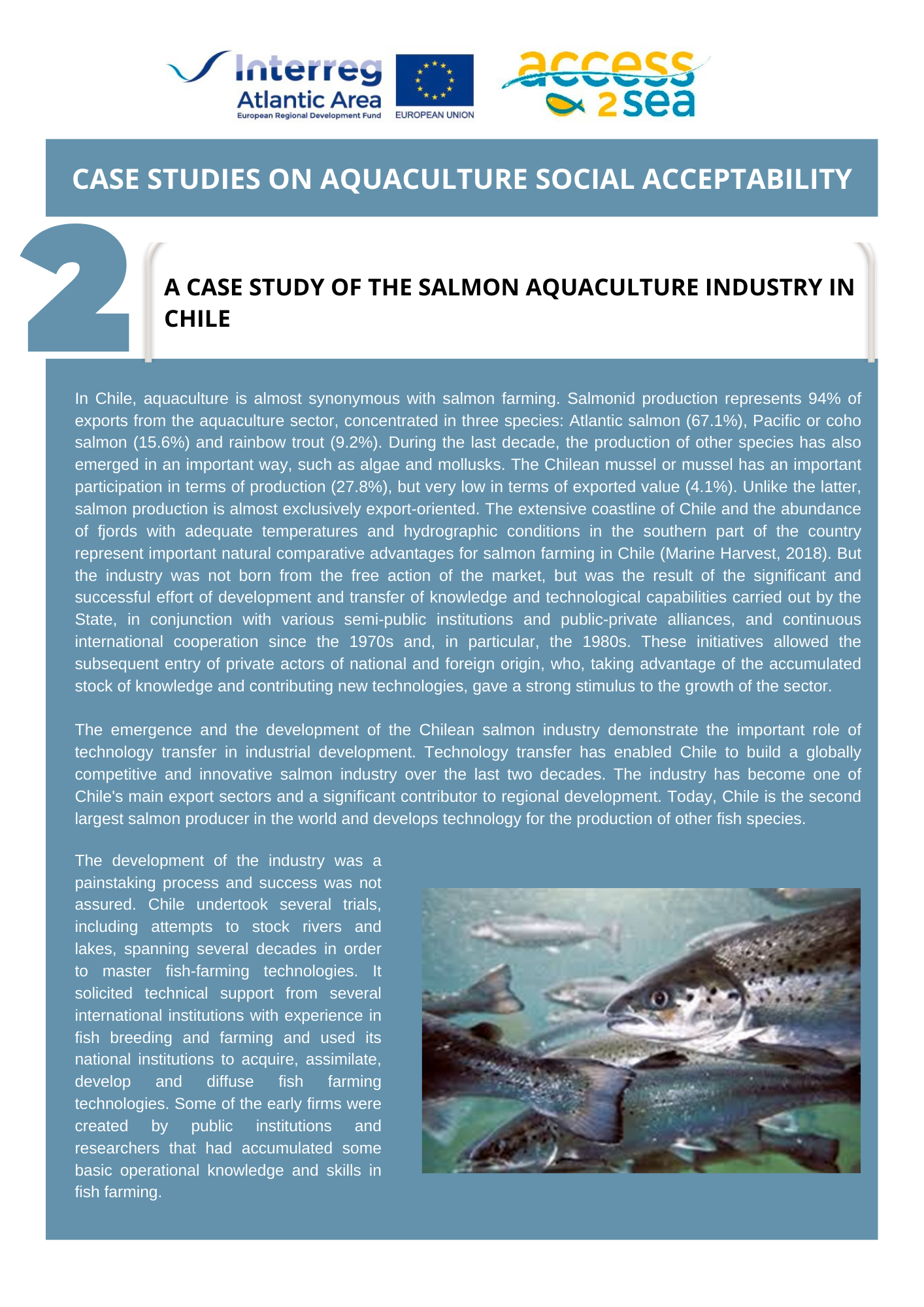
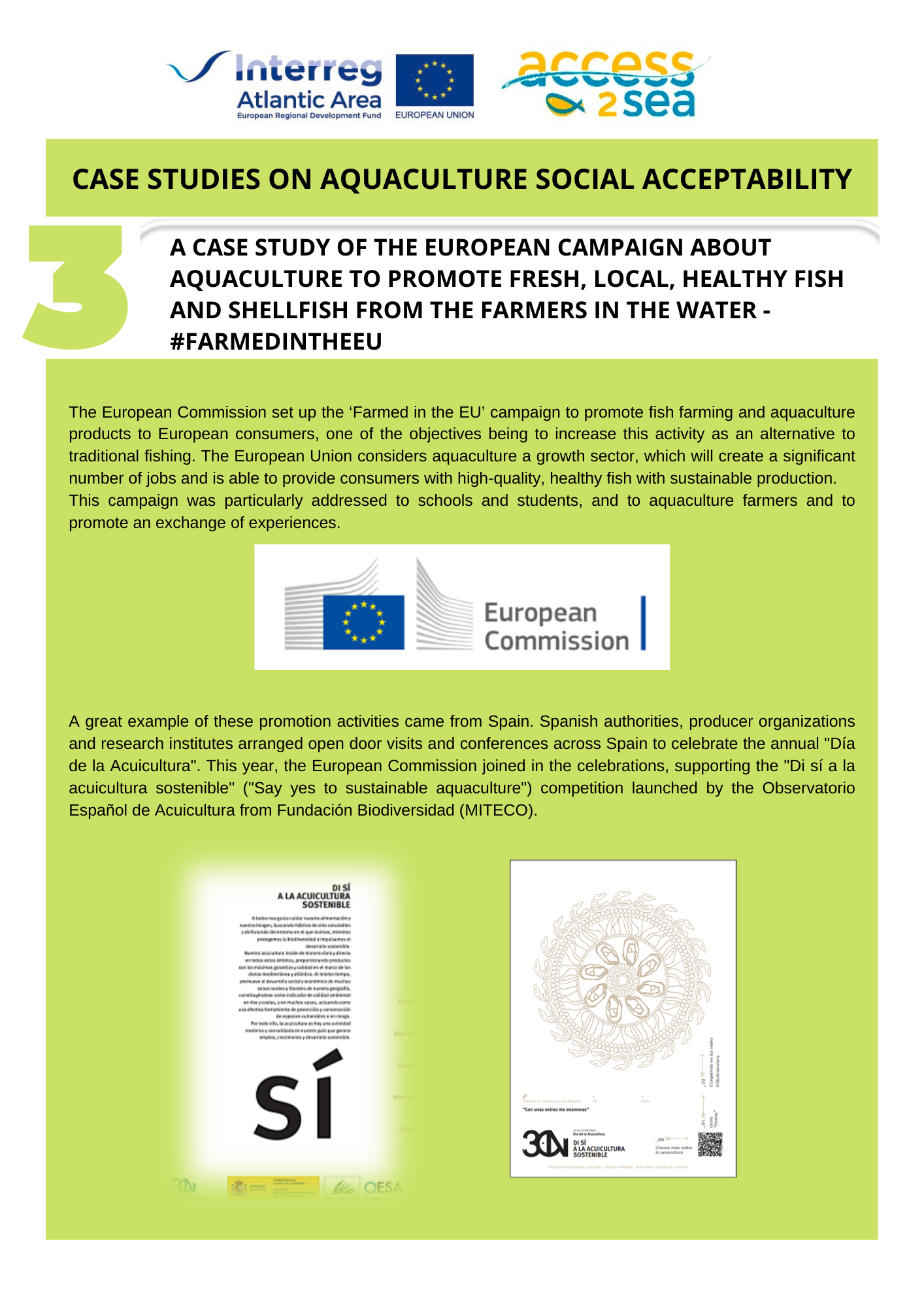
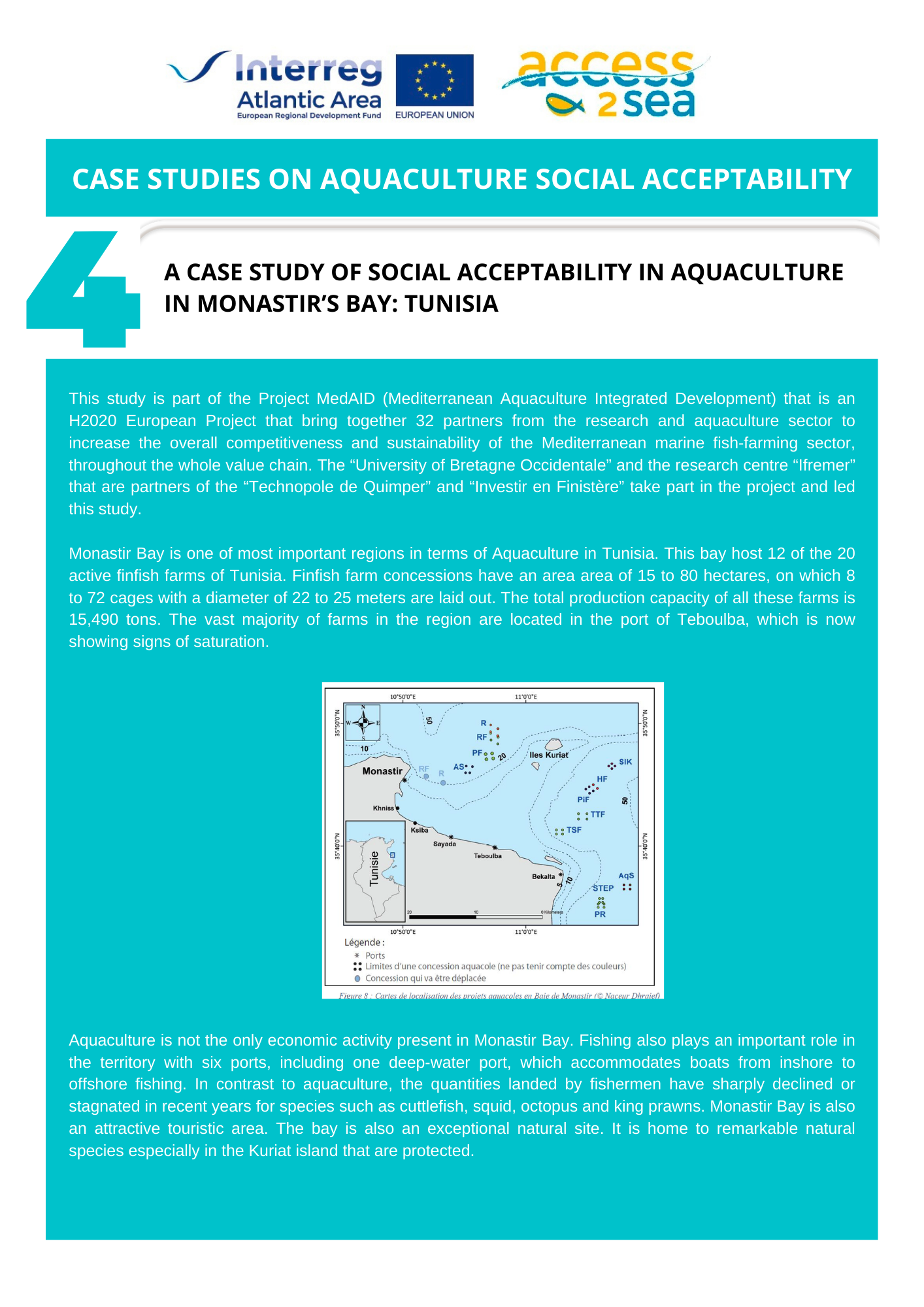
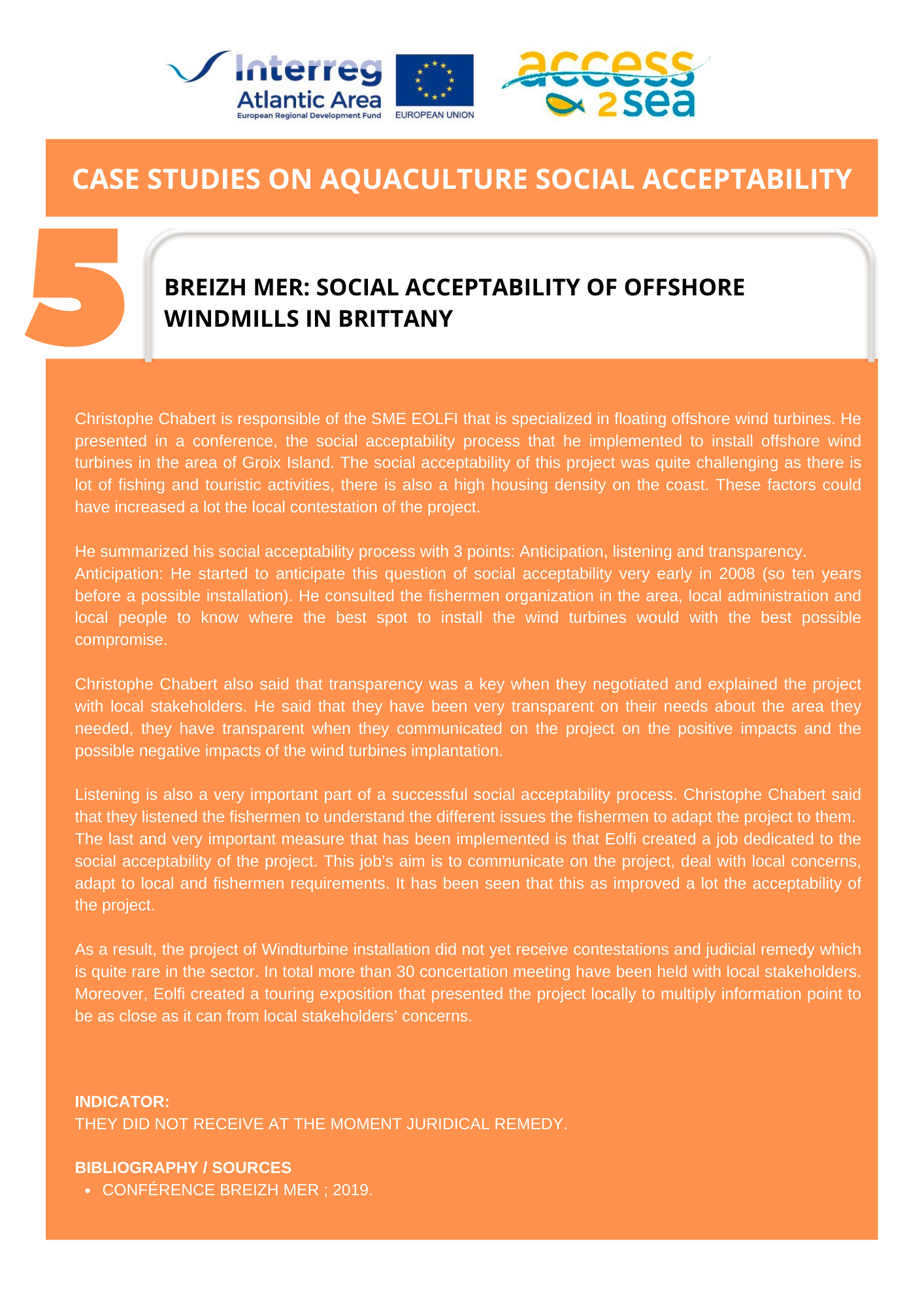
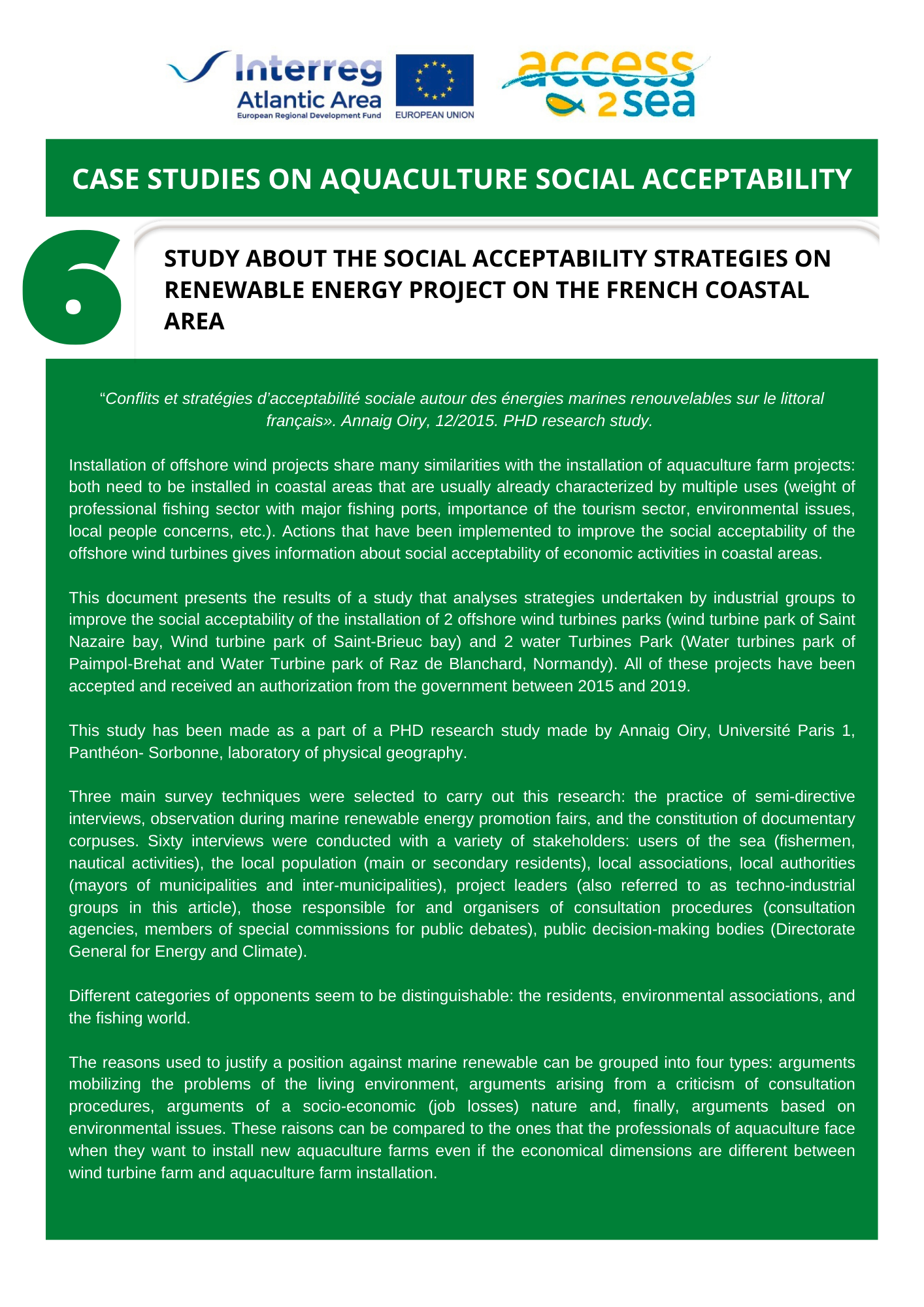
As result of this, 6 Case Studies of good practices were identified. These Case Studies encompass different aquaculture sepcies and marine development projects and geographical regions and resultad in valuable lessons.
You can read the Case Studies here:
3. Access2sea Social Acceptability Strategy
Access2sea partner have worked in the elaboration of a strategy with some actions and methodologies that can be implemented to improve social acceptability. This strategy is based in information that has been gathered with the collaboration of the Access2sea partners and their stakeholders. Here below it can be found the report produced as result of this work.
Two of the actions identified in this strategy have been implemented during the project implementation period:
- Pilot Project #4: Lump Fish Welfare Watcher.
- Implementation of a Social Acceptability Campain in Cádiz (Spain): #YoComproProductosdeAcuicultura (I buy Aquaculture Products)
4. BUSINESS MODELS BUILDING FOR AQUACULTURE FARMS
One of the aims of Access2Sea is to improve the business environment and the growth and jobs creation of the aquaculture sector in the project territories. In this section you can find the documents produced by the partners to achieve this aim:
1 Aquaculture SMEs Inventory
In their territories, the partners have carried out an inventory of the aquaculture companies established there to characterize their business model. The inventory has followed a common template to obtain a joint database that will be used to assess the degree of development and if there is any type of sectoral specialization of the aquaculture sector in the project regions and will be used as input for future actions of the project.
A report identifying and characterizing the aquaculture sector existing companies for the project territories can be read in the following link:
2. Regulatory and legislative frameworks inventory
The partners have characterized the regulatory and legislative frameworks of the project territories for the granting of licenses aquaculture farms on land and offshore (based on pre-existing studies) and has evaluated the Socio-economic impact on the coastal communities of the Atlantic zone. This analysis has been carried out following a template to allow comparison of data and develop an inventory of regulatory and legislative frameworks (highlighting best case models).
Here below, a report identifying and characterizing regulatory and legislative frameworks inventory in each of the Atlantic Regions involved can be found, as well as a common report with the project advancement in this field.
- Regulatory and legislative frameworks inventory – Overall Region
- Regulatory and Legislative Frameworks – Andalucía Region
- Regulatory and Legislative Frameworks – Brittany Region
- Regulatory and Legislative Frameworks – Irish Region
- Regulatory and Legislative Frameworks – Welsh Region
- Regulatory and Legislative Frameworks – Portuguese Region
3. Access2Sea Business Models
Based on the results of the previous actions partners will jointly identify the successful business models in place to be the base for developing the Access2Sea Business Models (ABM). They should allow the transfer of technical methods & represent legal solutions to overcame business constrains. ABM will be based on alternative sustainable business models like Community Entreprise Solutions & Social Entreprise Management Solutions. The guidelines for the models “usage” (road map) will be developed.
4. Inventory of new sustainable aquaculture techniques
The Access2Sea Project Partners have carried out a reserch and analysis of the new aquaculture techniques that are being developed at EU level, aiming at fostering a more sustainable industry, making a joint inventory of those which can answer to the needs and can be applied to the project territories companies, as well as develped a road map to support the technology transfer process.
Here below, a report identifying and characterizing new sustainable aquaculture techniques in each of the Atlantic Regions involved can be found, as well as a common report with the project advancement in this field.
- New Sustainable Aquaculture Techniques – Overall Report
- New Sustainable Aquaculture Techniques – Andalucía Region
- New Sustainable Aquaculture Techniques – Brittany Region
- New Sustainable Aquaculture Techniques – Irish Region
- New Sustainable Aquaculture Techniques – Welsh Region
- New Sustainable Aquaculture Techniques – Portuguese Region
5. PILOT PROJECTS
PILOT PROJECT IMPLEMENTATION
Based on the results of the different Work Packages, Access2sea partners worked together, sharing their knowledge, experiences, methodologies and tools, to develop project pilots that provide answers to the different key fields of the project:
- take advantage of business opportunities detected
- support the sustainable aquaculture activities (new and existing)
- improve the social acceptance of those activities
You can read more about the 5 different pilot projects here:
- PILOT PROJECT 1: Access2Sea experimental approach to expertise new aquaculture sites.
How to set up an onshore aquaculture site with seawater supply?
Investir en Finistère with its partner Technopole de Quimper Cornouaille and supported by professional federations and experts have just edited a guide to support aquauclture farmes. This methodology book details and explains all the steps to set up a project: from ratio and data to technical and legal indicators. Including practical analysis grids, this document helps to assess the suitability of a site.
This methodology is intended for:
-
- Entrepreneurs who are embarking on an onshore aquaculture project requiring seawater pumping, whether linked to an offshore concession or on their own and concerning different activities: shellfish farming, seaweed cultivation, fish farming, marine biotechnologies according to their specific needs,
- Technicians from public organizations and communities who are supporting a project on their territory or who wish to equip a site.
Pilot results:
WP7. Action 1. Aquaculture-sp-meth-guide-english-web
WP7. Action 1. Aquaculture_guide_complet_page_a_page
WP7. Action 1. New aquaculture sites
2. PILOT PROJECT 2: Aquaculture Activities instalation Pilot Project (Spain)
Pilot results:
Action 2a. Initial Evaluation of SME
Action 2b. Aquaculture Activities Installation
Action 2c. Advice for SMEs (Executive summary)
Action 2d. Advice for SMEs (KPIS)
Action 2e. Evaluation of SME (Final)
3. PILOT PROJECT 3: Sustainable Aquaculture Activities Pilot Project (Ireland)
Pilot Results:
WP7. Action 3. Sustainable aquaculture report
4. PILOT PROJECT 4: Aquaculture Activities for Social Acceptance Pilot Project (United Kingdom)
Pilot results:
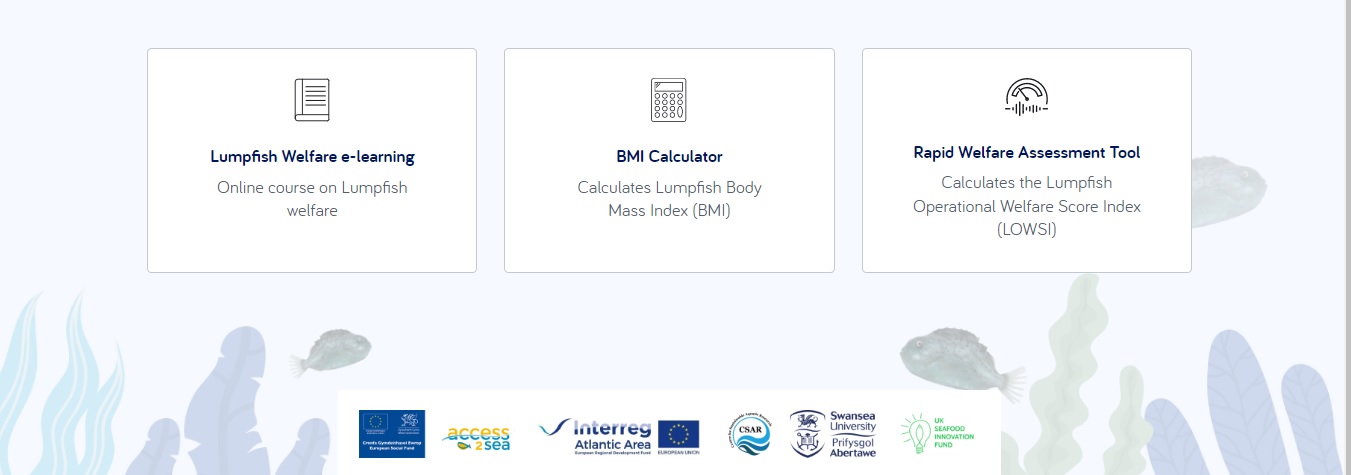
The Lumpfish Welfare Watcher is a web & desktop interface designed to help fish farmers assess and improve the welfare of Lumpfish based on the validated operational welfare score index known as the Lumpfish Operational Welfare Score Index or LOWSI.
Link to the LUMPFISH WELFARE WATCHER TOOL
The home screen has three tools available:
◼ Lumpfish Welfare e-learning
◼ BMI Calculator
◼ Rapid Welfare Assessment Tool
LUMPFISH WELFARE E-LEARNING
Clicking on the Lumpfish Welfare E-learning tool will open the free course in Lumpfish welfare.
This short online course provides essential information for both professionals and students on Lumpfish
welfare. It also shows how to score the lumpish visual indicators which is essential to use the Rapid
Welfare Assessment Tool.
BMI CALCULATOR
Pilot Deliverable:
WP7. Action 4. Aquaculture Social acceptance
5. PILOT PROJECT 5: Feed Intake Regulation as a Tool for Waste Management in Fish Production (Portugal)
Pilot results:
WP7. Action 5 Fish Intake regulation as a tool for wast4e management in fish production
6. Access2sea Newsletters
- Access2Sea Newsletter #1: March 2020
- Access2Sea Newsletter #2: July 2020
- Access2Sea Newsletter #3: November 2020
- Access2Sea Newsletter #4: June, 2021
- Access2Sea Newsletter #5: February, 2022
- Access2Sea Newsletter #6: June, 2022
- Access2Sea Newsletter #7: September, 2022
- Access2Sea Newsletter #8: December, 2022
Más información:
CEEI Bahía de Cádiz
C/ Manantial, 13, Pol. Ind. Las Salinas
11500 El Puerto de Santa María, (Cádiz)
Tel: +34 956860654 Fax: +34 956 860028
